
Achilles Tendon Ruptures: Types, Symptoms, and Treatment Options

An Achilles tendon rupture is a serious injury that can affect your ability to walk, run, jump, and participate in sports. Whether the injury occurs during an athletic activity or while performing everyday movements, a torn Achilles tendon can significantly impact your mobility and quality of life. Understanding the type of rupture, available treatment options, and expected recovery can help you make an informed decision about your care.
Dr. Sims is a board-certified orthopedic surgeon specializing in foot and ankle conditions, including Achilles tendon ruptures. His approach to treatment is individualized, taking into account the location and severity of the injury, your activity level, overall health, and personal goals.
What Is the Achilles Tendon and What Does It Do?

The Achilles tendon is the large, strong tendon that connects the calf muscles (the gastrocnemius and soleus) to the heel bone, also known as the calcaneus. It is the largest tendon in the human body and plays a critical role in everyday movement.
The Achilles tendon allows you to:
Walk and push off: It helps propel your body forward with every step.
Run and jump: It transfers force from your calf muscles to your foot.
Climb stairs and stand on your toes: It provides the strength needed to raise your heel.
Participate in sports: It helps with acceleration, sprinting, and sudden changes in direction.
When the Achilles tendon tears completely, the connection between the calf muscles and heel is disrupted. Patients may experience a sudden popping sensation, pain in the back of the ankle, swelling, bruising, and difficulty pushing off the affected foot. Some patients describe the sensation as being kicked in the back of the leg.
An Achilles tendon rupture can occur even in people who have no previous Achilles tendon pain. Prompt evaluation by an orthopedic specialist is important because early diagnosis and appropriate treatment can improve the chances of a successful recovery.
The Three Main Types of Achilles Tendon Ruptures
Achilles tendon ruptures are commonly classified according to where the tendon tears. The location matters because it can influence healing potential, surgical technique, rehabilitation, and the likelihood of returning to your previous level of activity.
1. Insertional Achilles Tendon Rupture
An insertional Achilles tendon rupture occurs where the tendon attaches to the heel bone, or calcaneus. This region may already have chronic degeneration, calcification, or a prominent area of bone sometimes associated with insertional Achilles tendinopathy.
These injuries can occur after a sudden forceful movement or in a tendon that has weakened over time. In some cases, a portion of the tendon may pull away from the heel bone along with a small piece of bone.
Treatment depends on the extent of the tear, the quality of the remaining tendon, and whether the tendon has detached from the bone. Some injuries can be treated without surgery using a carefully supervised immobilization and rehabilitation program. More severe tears or tendon detachments may require surgical reattachment to the heel bone, often using specialized anchors. If significant damaged tendon or bone is present, additional procedures may be necessary.
2. Mid-Substance Achilles Tendon Rupture
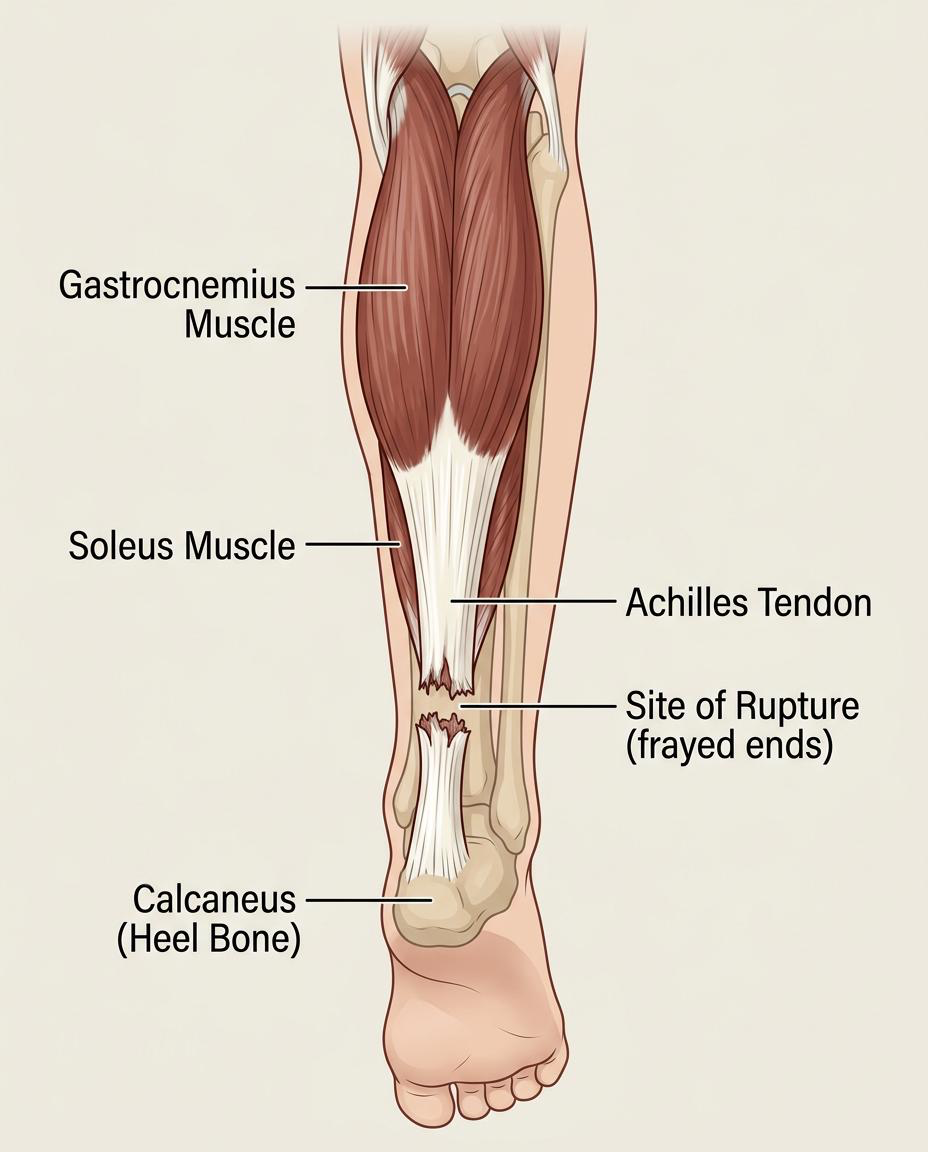
A mid-substance Achilles tendon rupture occurs in the middle portion of the tendon, typically a few centimeters above its attachment to the heel bone. This is the most common location for a complete Achilles tendon rupture.
These injuries frequently occur during sports involving sprinting, jumping, or sudden acceleration. However, they can also happen during routine activities when the calf muscle contracts forcefully while the ankle is moving upward.
Patients often report a sudden pop followed by pain, swelling, and weakness when trying to push off the foot. A complete tear may leave a gap between the tendon ends.
Treatment options include non-surgical management with a functional rehabilitation protocol or surgical repair to reconnect the torn tendon ends. The decision depends on factors such as the gap between the tendon ends, tissue quality, activity demands, medical history, and patient preferences.
Surgical repair may be particularly appealing to some patients who prioritize minimizing the risk of re-rupture or returning to demanding physical activities. However, surgery also carries risks, including wound complications, infection, nerve injury, and blood clots. The best approach should be determined individually rather than assuming that every rupture requires surgery.
3. Myotendinous Achilles Rupture
A myotendinous rupture occurs higher in the lower leg, where the calf muscle transitions into the Achilles tendon. This area is known as the myotendinous junction.
Unlike a typical mid-substance tear, a myotendinous rupture involves the transition between muscle fibers and tendon tissue. These injuries may occur during sudden acceleration, jumping, or forceful calf contraction.
Because this region contains muscle tissue with a blood supply, some myotendinous ruptures may heal successfully without surgery. Treatment often involves immobilization or a functional walking boot, temporary restrictions on weight-bearing when appropriate, and a progressive rehabilitation program.
Surgery may be considered in selected cases, particularly when there is significant disruption, persistent weakness, or an injury pattern that is unlikely to heal adequately with non-surgical care. Accurate diagnosis is important because treatment strategies for a myotendinous injury may differ from those used for a tear near the heel bone.
How Are Achilles Tendon Ruptures Treated?
There is no single treatment that is right for every Achilles tendon rupture. Dr. Sims evaluates the location of the tear, the amount of tendon separation, tissue quality, patient activity level, medical history, and personal goals before recommending a treatment plan.
Non-Surgical Treatment
Non-surgical treatment typically involves placing the ankle in a walking boot or cast with the foot positioned to bring the torn tendon ends closer together. As healing progresses, patients follow a structured rehabilitation program that gradually restores ankle motion, walking ability, and calf strength.
This approach can be effective for many patients, particularly when the tendon ends can heal in an appropriate position and the patient can follow the rehabilitation protocol closely. However, non-surgical treatment carries a risk of re-rupture. In a major randomized clinical trial published in the New England Journal of Medicine, the re-rupture rate was 6.2% with non-surgical treatment, compared with 0.6% after either open or minimally invasive surgical repair.
New England Journal of Medicine
These rates can vary depending on the injury, patient population, and treatment protocol. Non-surgical treatment also requires careful follow-up to reduce the risk of tendon elongation and persistent weakness.
Surgical Treatment
Surgical treatment involves repairing the torn tendon or reattaching it to the heel bone, depending on the location of the injury.
Surgical options may include:
Open Achilles tendon repair: An incision allows the surgeon to directly visualize and reconnect the torn tendon.
Minimally invasive Achilles tendon repair: Smaller incisions and specialized instruments are used to repair selected tendon tears.
Insertional tendon reattachment: When the tendon detaches from the heel bone, specialized anchors may be used to secure it back to the bone.
Complex or chronic rupture reconstruction: More extensive techniques may be necessary when the tendon is severely damaged, the ends cannot be brought together, or the injury has been present for an extended period.
Surgery may be appropriate for patients with certain injury patterns, high physical demands, or a preference to reduce the risk of re-rupture.
New England Journal of Medicine
Personalized Achilles Tendon Rupture Treatment With Dr. Sims
Dr. Sims is a board-certified orthopedic surgeon who specializes in foot and ankle conditions, including Achilles tendon ruptures. He understands that every patient has different needs, whether the goal is returning to competitive sports, maintaining an active lifestyle, or simply walking comfortably again.
His treatment recommendations are based on the specific characteristics of each patient's injury and the patient's individual goals. Some patients may benefit from a structured non-surgical rehabilitation program, while others may be better candidates for open or minimally invasive surgical repair.
Throughout treatment, the focus is on helping the tendon heal appropriately, restoring calf strength, improving mobility, and safely returning to desired activities. Rehabilitation is an essential part of recovery regardless of whether surgery is performed.
Get Back to Strength After an Achilles Tendon Rupture
An Achilles tendon rupture can be a frustrating and debilitating injury, but appropriate treatment and rehabilitation can help many patients return to their previous activities. Early diagnosis and an individualized treatment plan are important steps toward recovery.
If you suspect you have ruptured your Achilles tendon, prompt evaluation by an orthopedic specialist is recommended. Avoid trying to stretch or strengthen the injured tendon before it has been evaluated.
Dr. Sims will work with you to develop a treatment plan tailored to your injury and your goals, helping you get back to full strength again.


Comments